




 Ελληνικά
  English
  Deutsch


Hair Transplantation, Methods&& New Developments
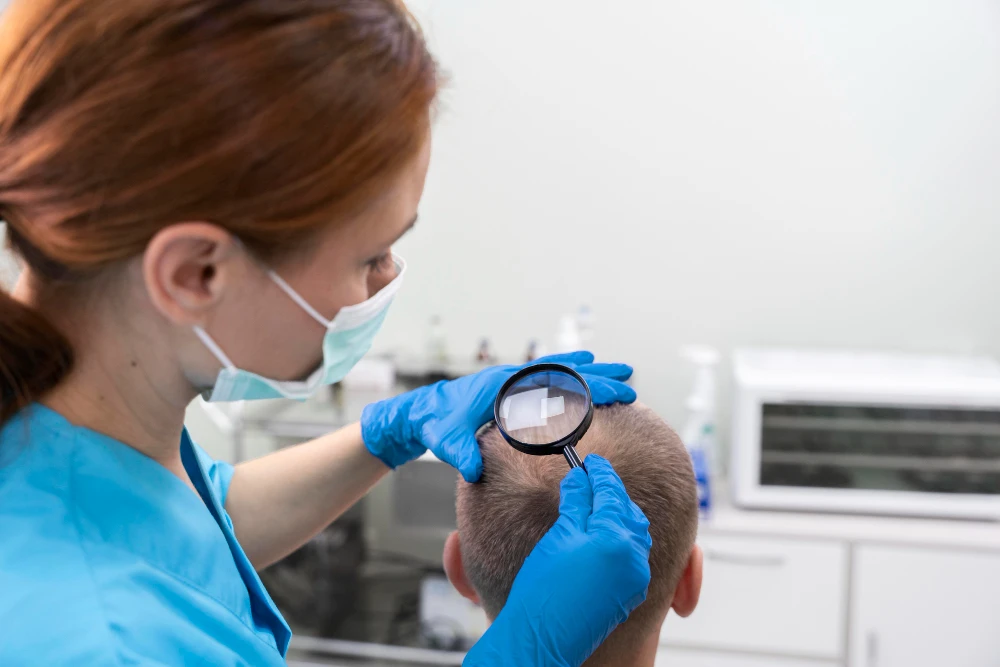
The use and significance of trichoscopy is not only a diagnostic tool but primarily is a method of objective measurements in terms of improvement and responsiveness to treatment.
It is the method of measuring hair thickness, but also the number and efficiency of active hair follicles, per square centimeter.
Features of Hair Transplantation F.U.E.
The FUE hair transplant stages are the following
- Pre-operatively, the donor area is defined and local anesthesia is applied.
- Hair follicles are extracted one-by-one using an automated FUE extracting device.
- The grafts are temporarily stored in a moist and cool environment of 2 to 4 degrees Centigrade.
- Design and mark up of the area where the hair follicles will be implanted.
7 axes, F.U.E.
- The grafts are our own hair follicles from the donor areaThe grafts are our own hair follicles from the donor area
- Transplantation is appropriate for both men and women
- Transplantation does not leave any signs
- Hair transplantation is absolutely safe and does not hurt
- Transplanted hair does NOT stand out from the rest of the hair
- Transplantation of hair follicles is done from the donor area and we never lose them
- The experience of the treating therapist is a key factor in the outcome of the transplant
Hair transplantation F.U.E.
The FUE method is the most modern method in hair transplantation, as it excels in three key points:
- Is carried out bloodlessly
- Does not leave scars
- Minimizes recovery time


The stages of dilution, in alopecia in men and women respectively:
The stages of dilution are shown in the table below:
-
Androgenetic alopecia in men
(The Hamilton and Norwood scale)
-
Androgenetic alopecia in women
(The Ludwig scale)
To decide if someone is a suitable candidate for hair transplantation, we have to take into account the following:
- If there is a stable donor area from which hair follicles are obtained
- If the recipient is a disease-free area that can either reduce hair follicle (eg scar) or threaten their survival (eg existing active disease
- For example, alopecia areata may affect a potential donor area as well as the ability of the recipient to accept the hair or to retain the hair follicles. The same applies to the cicatricial alopecia.